Abstract
Key Contributions
Method Overview
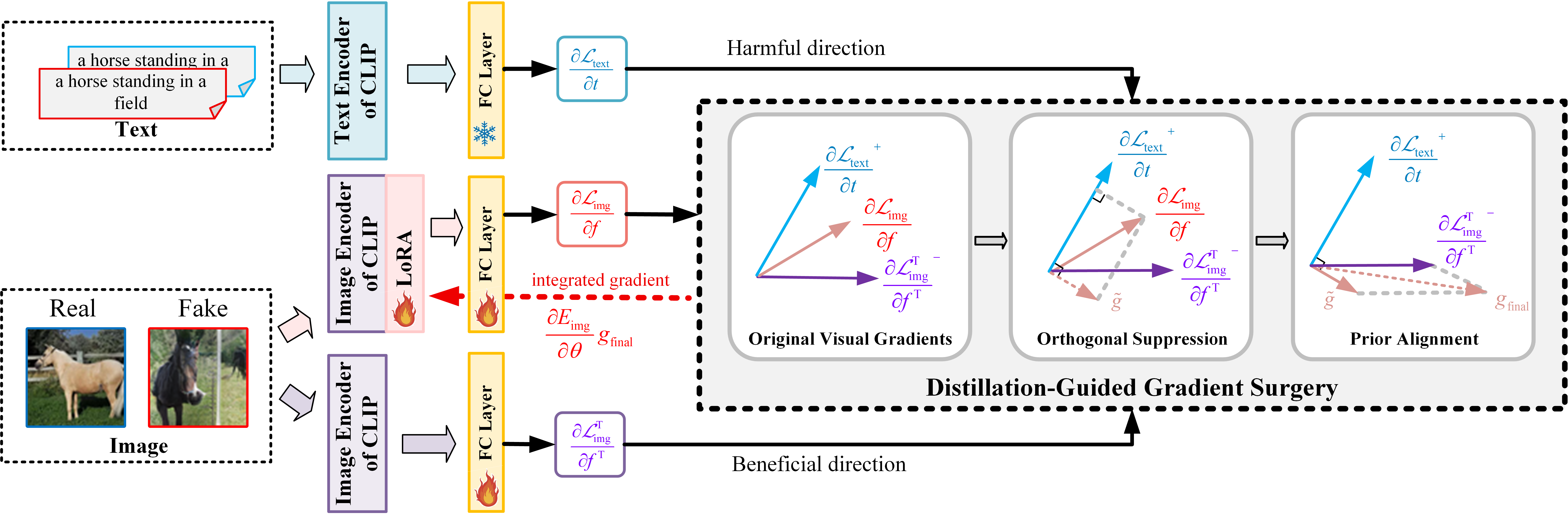
I. Orthogonal Suppression. The image gradients of the training network are orthogonally projected onto the subspace complementary to the harmful directions inferred from text gradients, thereby mitigating cross-modal interference.
II. Prior Alignment. The coordinate-wise negative components of the frozen CLIP image gradients are introduced as lightweight alignment signals to reinforce beneficial pre-trained priors.
Quantitative Results
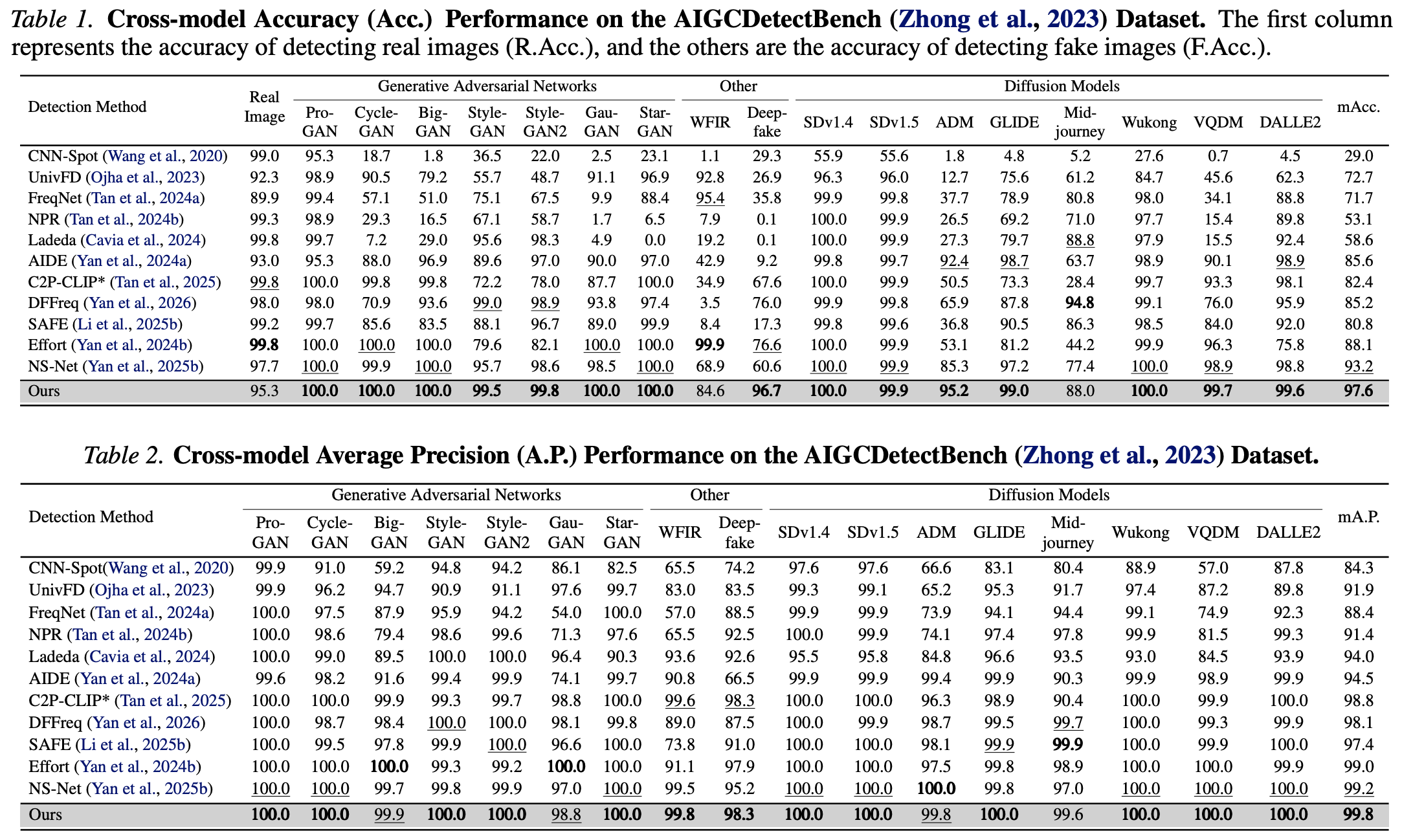
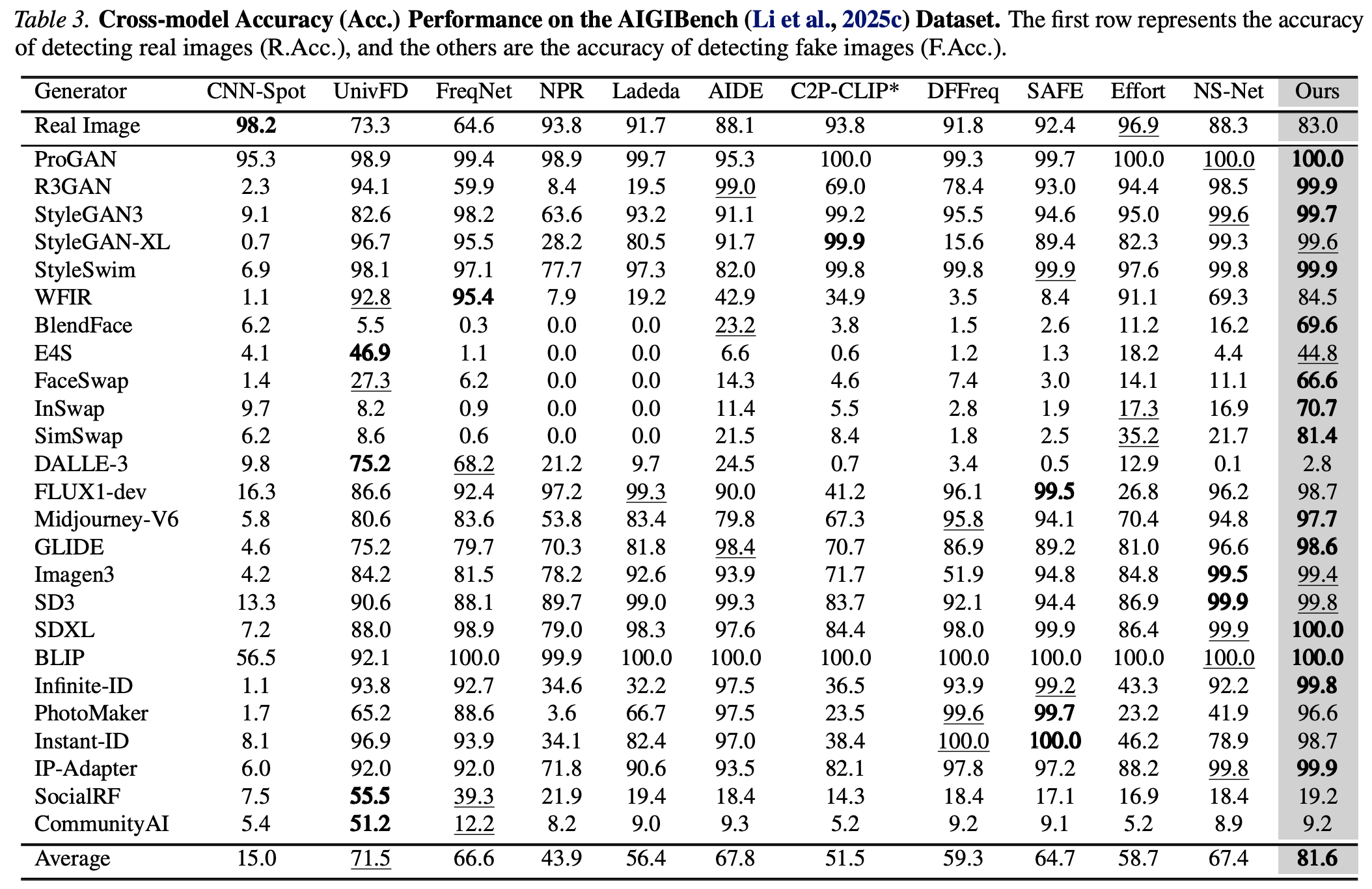
Overall, quantitative results confirm the effectiveness of our DGS-Net, which reserves transferable pre-trained priors while suppresses task-irrelevant knowledge, thereby improving both detection accuracy and cross-domain generalization.
BibTeX
@article{yan2025dgs,
title={DGS-Net: Distillation-Guided Gradient Surgery for CLIP Fine-Tuning in AI-Generated Image Detection},
author={Yan, Jiazhen and Li, Ziqiang and Wang, Fan and Wang, Boyu and He, Ziwen and Fu, Zhangjie},
journal={arXiv preprint arXiv:2511.13108},
year={2025}
}